

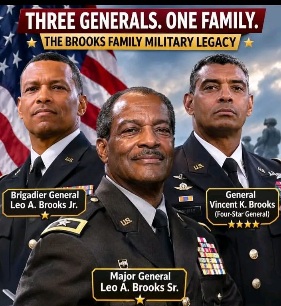
Imagine a family in which a father becomes a general in the United States Army, and both of his sons follow in his footsteps, eventually becoming generals themselves.
This is not fiction. It is the remarkable story of the Brooks family, one of the most extraordinary African American military families in American history.
At the centre of this story was Major General Leo A. Brooks Sr., whose military career helped establish a legacy that his two sons, Leo A. Brooks Jr. and Vincent K. Brooks, would carry even further.
1. MAJOR GENERAL LEO A. BROOKS SR. – THE FATHER WHO ESTABLISHED THE LEGACY
Born on August 9, 1932, in Alexandria, Virginia, Leo Austin Brooks Sr. grew up in a family with a longstanding military tradition.
He attended Virginia State University, where he earned a Bachelor of Science degree and distinguished himself as a Reserve Officers’ Training Corps (ROTC) graduate.
In 1954, he received his commission as a second lieutenant in the United States Army’s Quartermaster Corps.
Brooks subsequently served in different military assignments, including two tours during the Vietnam War.
His career involved significant leadership responsibilities, particularly in military logistics, supply management and support operations.
Among his important assignments were:
– Commander of the Sacramento Army Depot.
– Commander of the 13th Corps Support Command at Fort Hood, Texas.
– Commanding General of the U.S. Army Troop Support Agency.
– Commanding General of the Defense Personnel Support Center in Philadelphia.
These were important responsibilities because the effectiveness of an army depends not only on soldiers on the battlefield but also on the systems that provide them with food, equipment, transportation and other essential supplies.
Brooks rose to the rank of Major General, becoming one of the senior African American officers in the American military.
He retired from active military service in 1984 and subsequently served as managing director of the City of Philadelphia.
His military decorations included the Distinguished Service Medal, Defense Superior Service Medal, Legion of Merit and Bronze Star Medal.
But perhaps one of his greatest legacies would come through his children.
2. BRIGADIER GENERAL LEO A. BROOKS JR. – THE ELDEST SON WHO FOLLOWED HIS FATHER’S FOOTSTEPS
Born on August 15, 1957, in Anchorage, Alaska, Leo A. Brooks Jr. grew up in a military household.
His father’s military career provided an example of leadership and public service.
He attended the United States Military Academy at West Point, graduating in 1979 with a Bachelor of Science degree in engineering.
He began his military career in 1980 and served in several prestigious Army formations.
His assignments included service with the 101st Airborne Division and the elite 75th Ranger Regiment.
He also served with the 82nd Airborne Division, where he eventually commanded the 1st Battalion, 504th Parachute Infantry Regiment.
His career continued to advance through increasingly important leadership positions.
In 2002, he became the 68th Commandant of Cadets at the United States Military Academy at West Point.
This was a particularly significant appointment because the commandant plays an important role in military training, discipline and leadership development among future Army officers.
He eventually attained the rank of Brigadier General.
After approximately 27 years of military service, he retired in 2006 and subsequently held senior positions at Boeing.
He had followed his father’s footsteps, but he had also established his own distinguished military career.
3. GENERAL VINCENT K. BROOKS – THE YOUNGEST SON WHO ROSE TO FOUR-STAR GENERAL
The second son, Vincent K. Brooks, would go on to achieve one of the highest ranks in the United States military.
Like his older brother, he attended the United States Military Academy at West Point.
He graduated in 1980.
But even before graduation, he had already made history.
Between 1979 and 1980, Brooks served as First Captain of the Corps of Cadets, the highest-ranking cadet leadership position at West Point.
He became the first African American cadet to hold that position.
After graduating, he embarked on a military career that lasted more than four decades.
His assignments included service in the 82nd Airborne Division and several important command and leadership positions.
During the 2003 Iraq War, he became widely recognised as a military spokesperson, briefing international media about American military operations.
His ability to communicate military developments made him a familiar face during the early stages of the Iraq conflict.
He subsequently held several senior military commands.
Among his most significant appointments were:
– Commanding General of the U.S. Army Central Command.
– Commanding General of U.S. Army Pacific.
– Commander of United Nations Command in South Korea.
– Commander of U.S. Forces Korea.
– Commander of the Combined Forces Command in South Korea.
In 2013, he was nominated for promotion to four-star general.
He ultimately became one of the relatively small number of African Americans to attain the four-star rank in the United States Army.
After more than 42 years of military service, General Vincent K. Brooks retired in 2019.
His career represented another remarkable chapter in the Brooks family’s military history.
4. WHAT MADE THE BROOKS FAMILY HISTORICALLY REMARKABLE?
The remarkable achievement was not simply that three members of one family served in the military.
It was that a father and his two sons all attained general officer rank in the United States military.
According to historical accounts and Army officials cited in contemporary reporting, the Brooks family was recognised as the only African American family in U.S. Army history at the time to have produced three generals across two generations.
Their achievements were particularly significant in a country whose armed forces had experienced a long history of racial discrimination and barriers to African American advancement.
The family also demonstrates that military leadership can become a tradition passed from one generation to another.
Their mother, Naomi Brooks, was also an important part of the family’s story. She was a schoolteacher who supported the family while her husband pursued his military career, including during his overseas deployments.
The Brooks family had three children, including their daughter, Marquita K. Brooks, an attorney.
Their achievements were not the result of one man’s success alone. They reflected years of education, personal discipline, family support and individual commitment to military service.
A LEGACY THAT DESERVES TO BE REMEMBERED
Major General Leo A. Brooks Sr. established an extraordinary military legacy.
His eldest son, Brigadier General Leo A. Brooks Jr., continued it through his leadership at West Point and across the Army.
His younger son, General Vincent K. Brooks, took the family legacy even further by attaining four-star rank and commanding major American and international military formations.
Three generals. Two generations. One extraordinary African American military family.
Their story deserves a place in American military history.
