

By Sa’id Husain Abdullahi Kwajale-Sumaila
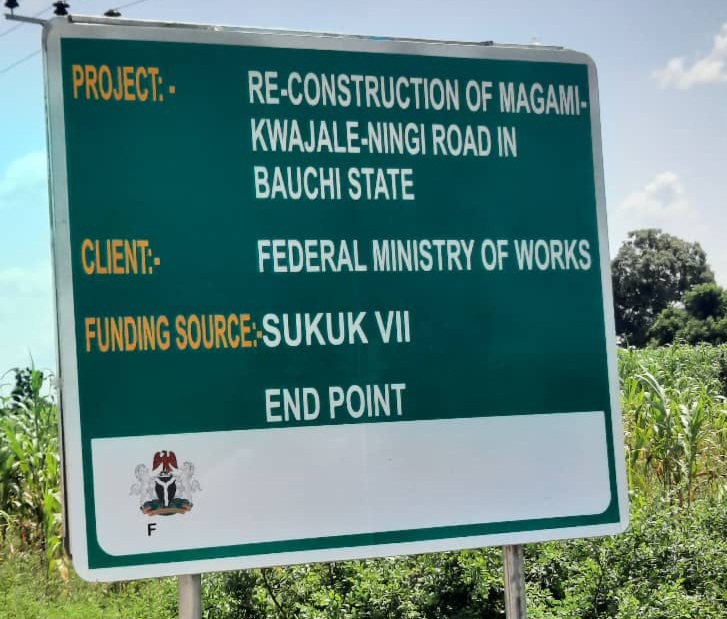
Seeing this project sign identifying Sukuk VII as the funding source for the Magami–Kwajale–Ningi Road brings back memories of a project I personally witnessed at its early stage.
Sometime in 2017/18, following the intervention of the then Senator representing the Kano South Senatorial District, Senator Kabiru Ibrahim Gaya, I had the privilege of accompanying the consultant who inspected the proposed route on the ground.
What we inspected that day was considerably more than what the simple description “Magami–Kwajale–Ningi Road” might suggest.
Starting from Magami, we crossed the river forming the boundary between Kano and Bauchi States and proceeded through Kafin Lemo to Ruwan Ɗinya, where the proposed road was to connect with the existing Ningi–Burra road, constructed during the administration of the then Governor of Bauchi State, His Excellency Alhaji Isa Yuguda.
We subsequently returned to Magami and inspected another proposed alignment on the eastern side of the town, where a bridge was to provide a more direct connection towards Ruwan Ɗinya.
From the western side of Magami, another proposed route and bridge would connect through Kakimatsi, Kwalele, Galagandi, Sansani, Gamawa, Kwajale and Mako. We also passed through Dagora, Madobi and Gani before returning to Kano after what was essentially a full day’s field inspection.
I remember this particularly because the terrain is not a simple one. The area experiences substantial annual rainfall, with numerous streams and water crossings. Consequently, the project necessarily involved not only road construction but also bridges, smaller bridge structures, culverts and drainage works. These are important components when considering the scale and cost of the project.
The project subsequently reached the Federal Executive Council.
Contemporary reports from May 2018 stated that the Federal Executive Council approved the 58.9-kilometre Magami–Kwajali–Lingi road connecting Kano and Bauchi at a cost of ₦15.454 billion, following a presentation by the then Minister of Power, Works and Housing, Babatunde Fashola. The reports’ spelling of “Lingi” appears to have been an error; Federal budget documents consistently identify the destination as Ningi.
Interestingly, the road had already appeared in the Federal Government’s capital budget. The 2017 budget provided about ₦434.4 million, while the 2018 Appropriation Act provided about ₦968.1 million for the project. It subsequently continued appearing as an ongoing project in later Federal budgets.
This therefore was not a project conceived yesterday.
It has a history going back almost a decade.
And now we have Sukuk VII.
The present sign identifies Sukuk VII as the funding source.
There is nothing imaginary about Sukuk VII. The Federal Government’s Series VII Sukuk was a ₦300 billion infrastructure financing programme, with the proceeds intended for the construction and rehabilitation of Federal roads and bridges. The instrument carries a seven-year tenor and a 19.75% annual rental rate.
The interesting question, therefore, is not whether Sukuk VII exists. It certainly does.
The interesting question is how the present Sukuk VII-funded intervention relates to the original Magami–Kwajale–Ningi project approved by FEC in 2018 for ₦15.454 billion.
Has the present project:
continued the original 2018 contract?
been re-scoped?
been re-awarded?
been divided into phases?
or simply received a new financing arrangement under Sukuk VII?
These are legitimate questions, particularly because the road continued appearing in Federal budgets for several years after the original FEC approval. Appropriation, of course, should not automatically be interpreted as money actually spent; releases and actual expenditure would have to be established separately.
Why this road matters.
For people living along this corridor, this is not merely another line in a Federal budget.
A properly completed road would open up communities on both sides of the Kano–Bauchi boundary, improve access to markets, schools and health facilities, facilitate movement of agricultural produce and strengthen the connection between the Sumaila/Magami/Kwajale axis and the Ningi–Burra road network.
And because of the numerous streams and water crossings in the area, the quality of the bridges, culverts and drainage structures will be just as important as the asphalt pavement itself.
This is why those of us who know the terrain will be watching the project with particular interest.
A project worth completing — and worth monitoring.
I am not raising these points to cast doubt on the present project. On the contrary, I welcome any genuine effort to finally deliver this long-awaited infrastructure.
But after nearly a decade of budgetary history, an FEC approval of ₦15.454 billion, and now the appearance of Sukuk VII on the project sign, the people have every right to understand the project’s present status.
What matters now is not merely the signboard.
What matters is seeing the bridges constructed, the culverts properly installed, the road completed to the required standard, and the communities that have waited for this connection for years finally benefiting from it.
I was there when the proposed route was being inspected in 2017/18. I remember the terrain, the streams and the communities through which the road was expected to pass.
Nearly a decade later, it would be gratifying to see the vision that began with that field inspection finally become a completed road.
May Allah make it a reality and a lasting benefit to the people of the affected communities.
Saiduhabdullahi59@gmail.com/ 07066511495
