

By Lawan Musa Danlami (Baba Lawan)
The history of Kano contains a warning that should not be ignored in the present dispute over the Kano Emirate. More than 130 years ago, Kano experienced one of the most consequential internal political crises in its history—the Kano Civil War of 1893–1895, popularly remembered as the Basasa. It emerged from a succession dispute within the Dabo dynasty but eventually developed into a much broader struggle involving competing political factions, royal interests, military forces and regional powers.
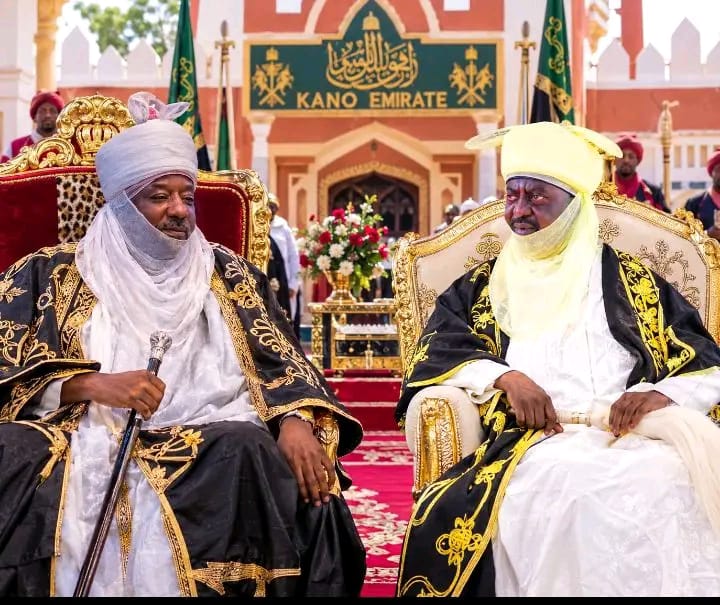
Today, Kano is again experiencing a prolonged dispute over the emirship involving Muhammadu Sanusi II and Aminu Ado Bayero. The circumstances are fundamentally different from those of the nineteenth century: today’s dispute is taking place within a constitutional democracy, under state legislation and judicial review rather than through armed confrontation. The Supreme Court has also adjourned proceedings in the wider emirate dispute until April 2027.
Yet history remains relevant because institutions can reproduce old patterns even when circumstances change.
The central question, therefore, is not who should be Emir. That is a matter for the appropriate legal and traditional processes. The historical question is more profound: what can Kano learn from the experience of the Basasa before political disagreement over the throne becomes more damaging to the institution itself?
The Basasa Began as a Succession Question—and Became Much More Than That
Adamu Mohammed Fika’s seminal study, The Kano Civil War and British Over-rule, 1882–1940, published by Oxford University Press in 1978, remains one of the principal scholarly works for understanding the crisis. Fika’s book places “Kano on the Eve of the Civil War” at the beginning of his discussion and devotes a substantial section to “The Civil War” before moving to the British conquest of Kano in 1903.
The dispute emerged after the death of Emir Muhammad Bello in 1893. Competing sections of the Dabo dynasty supported different claims to the throne. The supporters of Muhammad Tukur, son of Muhammad Bello, became associated with the Tukurawa, while supporters of Yusuf, from another branch of the dynasty, became known as the Yusufawa.
The significance of Fika’s analysis is that the conflict cannot adequately be understood as a personal quarrel between two princes. It reflected deeper contradictions within Kano’s political order.
Historian Yves Person, reviewing Fika’s work, described the book as a systematic analysis of the political crisis that culminated in the 1893–1895 civil war and emphasised the internal contradictions that characterised Kano’s political system.
That observation offers an important lesson for contemporary Kano: when a disagreement over leadership begins to represent competing political camps, the original dispute can become much larger than the individuals who started it.
When The Throne Becomes The Battleground
The Basasa demonstrates the danger of turning the institution of the emirship into a permanent battlefield for competing political loyalties.
Once the Yusufawa and Tukurawa became organised around rival claims, the disagreement was no longer confined to the palace. Political officials, military forces, influential families and external interests became involved.
Modern Kano has a different institutional framework, but the possibility of polarisation remains. The contemporary dispute has involved competing claims, court proceedings, government actions and different groups identifying themselves with opposing sides.
The difference is crucial: today’s disagreement is not a civil war, and there is no historical basis for predicting that it will become one. The lesson from the Basasa is instead that political leaders and citizens should recognise early the danger of allowing institutional disagreement to harden into permanent factionalism.
The Real Casualty of Prolonged Succession Conflict is Often The Institution Itse
The most important historical lesson may be found in what happened to Kano after the Basasa.
The conflict disrupted the emirate’s political and economic life. Scholarly work drawing on Fika and other historians notes that the war seriously disrupted commercial activity, while Kano’s position as a major trading centre meant that the consequences extended beyond the immediate combatants.
Kano was not merely a palace. It was a commercial and political centre whose stability affected a much wider region.
That is why the modern dispute deserves to be approached beyond the question of who occupies a particular palace.
The deeper question should be:
What happens to the authority, unity and public confidence of the Kano Emirate when its leadership remains contested for years?
This is the historical lesson that should concern everyone—not merely supporters of either claimant.
The Danger of Royal Succession Into a Political Zero Sum Game
The Basasa demonstrates another recurring problem in political history: when each side believes that the other’s victory represents its own defeat, compromise becomes extremely difficult.
The modern Kano dispute has likewise developed within a wider political environment. The emirate structure was altered under successive state governments, and the 2024 repeal of the 2019 emirate law resulted in the restoration of the former single-emirate arrangement and Sanusi’s reinstatement. Aminu Ado Bayero’s legal challenge has continued through the courts. The Court of Appeal in January 2025 ordered a fresh hearing in one aspect of the litigation and addressed questions concerning jurisdiction and fair hearing.
These developments illustrate why the dispute should ultimately be understood through law, procedure and institutional legitimacy, rather than through political mobilisation alone.
History Warn Against Making Personal Loyalty Bigger Than Kano.
The Basasa involved competing members of the same ruling dynasty. Yet once political loyalties hardened, the conflict affected the wider society.
That should be a warning to contemporary Kano.
Sanusi Lamido Sanusi and Aminu Ado Bayero are individuals occupying positions within a much older institution. The Kano Emirate existed before either man and, regardless of the outcome of the present dispute, its institutional future will extend beyond both.
Therefore, the important civic question is not simply:
“Whose side are you on?”
It is:
“What kind of Kano Emirate will remain after this dispute is resolved?”
That is a fundamentally different question.
The Courts Provide Something The Basasa Generation Did Not Have
There is one decisive difference between nineteenth-century Kano and present-day Nigeria: modern constitutional institutions provide legal mechanisms for resolving disputes.
The Basasa generation ultimately resorted to military struggle. Contemporary Kano has courts capable of examining legislation, jurisdiction, procedure and competing claims.
The continuing litigation therefore provides an institutional alternative to political confrontation.
The January 2025 Court of Appeal decisions, for example, demonstrated that different legal questions within the dispute require judicial examination rather than political assumption.
The appropriate historical lesson is therefore not that one side should surrender its claim. It is that all sides should allow legal questions to be determined through due process and respect the distinction between political disagreement and judicial adjudication.
When Two Palace Speak, One Emirate Listens
The contemporary situation has produced an unusual spectacle: competing claims to the Kano throne and parallel centres of traditional authority.
Reporting in 2026 described the continued standoff and noted that the dispute had affected public traditional activities, including the suspension of the Durbar.
This is where the historical memory of the Basasa becomes particularly relevant.
The issue is not simply the physical possession of a palace. A traditional institution derives much of its strength from recognition, continuity and social acceptance.
If different sections of society increasingly identify with separate centres of traditional authority, the long-term question becomes whether the institution can continue to speak with one voice.
The Economy Should Not Become an Unintended Victim
One of the clearest lessons from the Basasa is economic.
Historical research indicates that the civil war disrupted Kano’s commercial activities and caravan trade. Because Kano was an important commercial centre within the Sokoto Caliphate, instability in Kano had consequences beyond the city itself.
Modern Kano’s economy is vastly different, but the principle remains relevant.
Kano’s stability matters to traders, farmers, manufacturers, transporters, investors, students, civil servants and millions of ordinary citizens.
A prolonged political or traditional dispute may not produce nineteenth-century warfare, but persistent instability can still affect public confidence, institutional cooperation and economic activity.
The lesson from history is therefore simple:
Kano’s political institutions should serve the stability and welfare of its people, not become permanent sources of uncertainty for them.
The Lesson of The Yusufawa And Tukurawa: Rival Camps Can Outlive The Original Dispute
One of the most significant characteristics of the Basasa was the emergence of durable factional identities around competing claims.
Modern Kano should be careful not to reproduce that pattern.
Political disagreements can end. But political identities created during prolonged conflicts can survive for generations.
That is why reconciliation after a succession dispute is just as important as determining succession itself.
A legal victory may settle a case; it does not automatically heal a society.
An appointment may settle the occupant of a throne; it does not automatically restore institutional unity.
The Emirate is Older Than The Dispute
This perhaps is the most important lesson of all.
The Kano Emirate has survived dynastic transitions, political upheavals, the Sokoto Caliphate period, the Basasa, British conquest, colonial administration, independence, military rule and democratic government.
Individuals come and go.
Political administrations come and go.
But the institution remains.
Therefore, the responsibility of political authorities, royal families, traditional titleholders, scholars and citizens should be to ensure that temporary political disagreements do not inflict permanent institutional damage.
What The Scholars Record Tells Kano
Fika’s work is particularly valuable because he situates the Basasa within a much wider transformation of Kano rather than treating it as an isolated royal quarrel. His study moves from the political crisis and civil war to British conquest and then to the transformation of Kano under colonial rule.
Yves Person’s review similarly emphasised the internal contradictions revealed by the crisis.
Later scholarship has also shown that the consequences of the civil war extended into questions of political legitimacy and the subsequent administration of the emirate. One study of colonial Kano notes that the appointment of Emir Abbas after the British conquest reopened tensions because it placed the emirship within the family associated with the Yusufawa, while those who had fought against the British could retain grievances.
This is an important intellectual observation: the end of a political conflict does not necessarily mean the end of its political consequences.
That is precisely why contemporary Kano should think beyond the immediate dispute.
The Choice Before Kano is Bigger The Between Two Claims
The present emirate dispute has its own legal history, and the courts will determine the legal questions before them. As of April 2026, the Supreme Court proceedings concerning the wider Kano Emirate dispute had been adjourned to April 2027.
But while the courts determine the legal dimensions, Kano’s society must also consider the institutional and social dimensions.
The historical record provides several questions worth asking:
Can disagreement exist without destroying unity?
Can political authorities exercise their legal powers without permanently politicising traditional institutions?
Can royal families disagree without dividing the wider society?
Can supporters of competing claims accept a lawful resolution even when it does not favour their preferred side?
Can Kano preserve the dignity of the emirate regardless of who eventually occupies the throne?
These are not questions that belong exclusively to Sanusi, Ado Bayero, the Kano State Government or the courts. They concern the future of Kano as a political, cultural and historical community.
Kano Must Learn From The Past Without Becoming a Prisoner of it
The Basasa should not be used as a political weapon against either claimant in the present dispute.
History should illuminate, not inflame.
The nineteenth-century conflict tells us what can happen when succession, legitimacy, political competition and factional mobilisation become intertwined. The present dispute provides an opportunity to apply that lesson without repeating the historical experience.
The greatest achievement would therefore not be for one faction to humiliate another.
It would be for Kano to reach a lawful resolution while preserving the dignity of the emirate, the unity of the people and the continuity of an institution older than the political dispute itself.
The history of the Basasa ultimately leaves Kano with a simple warning:
A throne can be occupied by one person, but the consequences of fighting over it are carried by an entire society.
That is why the lesson of 1893–1895 should not be Tukurawa versus Yusufawa.
It should be Kano before faction. Kano before personal rivalry. Kano before political interest.
And above all: The institution must survive the dispute.
Reference
Fika, Adamu Mohammed. The Kano Civil War and British Over-rule, 1882–1940. Ibadan: Oxford University Press, 1978. Fika’s principal treatment of the crisis is in the sections beginning with “Kano on the Eve of the Civil War” and “The Civil War.”
Person, Yves. Review of Fika, The Kano Civil War and British Over-rule, 1882–1940, Outre-Mers. Revue d’histoire, 1980. Person emphasises Fika’s analysis of Kano’s political crisis and internal contradictions.
Sa’id, Halil I. Review of Fika’s book, The Journal of African History, Vol. 24, No. 1, 1983, pp. 123–124.
Tukur, Mahmud. Scholarship on the political transformation of Kano and the Sokoto Caliphate, as discussed in later studies of colonial Kano.
Lovejoy, Paul E. Research on Kano’s nineteenth-century commercial importance and the effects of political disruption on trade, cited in later scholarship on the Civil War.
Contemporary legal reporting on the Kano Emirate dispute, including the Court of Appeal proceedings and the continuing Supreme Court litigation.
Abuja Network News
lawanm722@gmail.com
